
|
|
The Prez sez - |
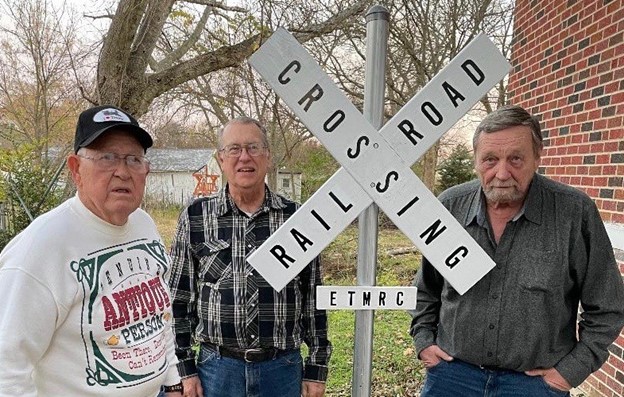
Sign Crew — George F, (left), creator of the new ETMRC sign and President Paul and Tom M pose with the new club signpost after installing it out beside the entry door. George’s sign is about half scale version of the real thing, made of wood with a steel fence post. The whole thing is set in a concrete footing, so should be secure well into the future. Photo: Dave G.
We had our final open house for 2021. Six members, Paul, Ron, Tom M, Bob E, George F, and Dave G spent the Saturday morning of the Commerce Christmas parade dusting, adjusting, hanging drop cloths, making the layout spic and span from top to bottom. Two passenger trains were assembled, Dave G’s heavyweight Southern RR train and Ron’s lightweight L&N train, and a couple freight trains were ready to go. Outside, the new club sign (see photo above) was installed, and the open house signs posted. They were ready. As the 3:00 pm opening of the event in the city drew near, they started running trains and encountered a couple of troublesome spots which were quickly fixed. Even a few locomotive problems were encountered and fixed. Everyone was having a good time, which continued through the afternoon.Visitors never appeared. When the clubhouse was closed down about 7:00 pm, we had set a new record: not one single visitor. But the members finally achieved what president Paul has urged over and over, they ran trains, hassled each other mercilessly, and had a good time. And that was worth more than anything else. And we can do that anytime. We don’t need an excuse to enjoy our layout or our members.
Cards and Patches. Dave G delivered the first package of compact club information cards. They have a photo of our building and a map of how to get there from major streets one side and some icons and our address on the other side. Both sides are in color. They are an ideal way to publicize our presence with folks who show an interest in model railroading. Please pick up a couple and carry this in your billfold and offer them to others who may be interested. Also, we got a new supply of patches, this time in two slightly different proportions. One size is the same as the first batch, which had dwindled down to a single patch on hand. The other size is slightly smaller and might be more useful on baseball caps and other applications. They are from the same maker as our original group and are identical except for the new size.
Oops: The last NL got two things wrong. Most important, the member helping Paul with the yard electrical work was Bob A. If that wasn’t bad enough, the date for the Parade open house was wrong. We’ll be more careful in 2022.
The official weekly club work sessions are 9:00 to noon on Saturdays. The business meeting is the first Saturday of the month at sort of the same time. it is best to call someone. Some members are often present for work sessions, or just plain lollygagging on Wednesday and Friday mornings, about the same time as the Saturday schedule. If you want to come on a weekday morning and don’t have a key, call someone. Early breakfast meetings are at McKay’s restaurant in Commerce.
The next scheduled business meeting is 9:00 am, January 8, 2022
Bob Erwin, Secretary
MEETING CALLED TO ORDER: December 4, 2021, 9:08 am
PRESENT: Tom B, Bob A, George W, Roger, Paul, Ron, George F, Bill L, Bob E
PROXIES: Bill M, Dave G
MINUTES OF PREVIOUS MEETING: Approved as published.
TREASURER'S REPORT: Submitted by Treasurer Ron M
This section is redacted.
COUNCIL MEETING REPORT: Paul Fogle, Representative
Plano winter train show still scheduled for January 15-16, 2022. Seller tables are oversold, so we won’t be there, No tables available.
CLUB BUSINESS:
OLD BUSINESS: Paul asked group who had not met Mike Newell. Mike is a new member who retired from Cotton Belt and Union Pacific. Next time you see him, welcome him. Paul next brought up the problem we had last week with switches. It was a 9 volt problem that was solved by going to the console panel. Some switches on the panel were misaligned. Paul will gladly show anyone the procedure used to solve the problem. He also thinks the next problem will involve a nearby Tortoise Machine.
Open House will be held December 11, 2021. The Chamber of Commerce, the organization responsible for the Bois d’Arc Christmas festival and Parade opens at 3:00 pm, but the parade doesn’t begin until 6:00. The CoC does not publish any programs or otherwise advertise events associated with the parade, but they plan to announce our Open House at the 3:00 pm. opening. Paul also appealed for help in getting the clubhouse ready for the open house putting up the layout skirts. He also ran through the list of things to be done in order to prepare the space for an open house.
Next item was the roof. No one he has contacted for an inspection has submitted an estimate, even if they showed up for an inspection. Paul called an operator at the Police radio room learned that their end of the annex roof had been repaired, His contact looked up the used company who repaired the library roof. Paul has the name of this company and will contact them soon.
NEW BUSINESS: Dave Gorman has designed and printed business cards for use by membership. These cards are on the lectern where the guest sign in sheet is located.
Paul also announced that Bob Teeter will call this morning at 9:30. He wants someone appointed to be head electrician for ETMRC. Paul will share with him the club volunteered Tom McCune, who was absent from the meeting, to assume this responsibility.
Discussion followed centered around permanent outside sign for club identification. Major concern was the possibility of theft. Bob Austin suggested that the sign be made of wood to prevent such theft.
MEETING ADJOURNED: 9:20 am
The following web sites are excellent sources of supplies (1) and data (3). (2) Is Rob D’s blog on the Model Railroad Hobbyist website. It is updated almost daily. Site (3) has some interesting photos of Commerce area railroading over the years.
This is usually a sampling of that’s going on in our area, which is defined to be whatever I think interesting, so the area can be fairly large. Or not.
Meet Mike Newell, Mike is our newest member and was a career railroader on the Cotton Belt and successors. This is his story, and the photos are from his collection.

How I got into trains
By Mike Newell
I guess I can blame my father for my interest in trains. He got me a Lionel tinplate trainset when I was about six, and then constructed a layout in our house in Garland that ran from the kitchen to my bedroom. That layout included a straight run down the hall about 20 feet with return tracks and some sidings at each end. It was great fun. Eventually we had two locomotives, a die cast 2-6-4 steam locomotive and a smaller 2-4-2. The little 2-4-2 was fast— you could open it up on the long straight stretch and send it into orbit at the sharp curves in both ends. As I got older, I started getting interested in HO scale. The proportions were better, and the track had just the two rails the real railroads have. So, when I was about 31, I traded in the Lionel trains to Bobby Hall’s Hobby House in Dallas for some early Athearn locomotives and some track. I built a small layout in my garage, but the 20 fool long speedway was gone.
This phase ended when I graduated from Garland High School and went off to the North Texas State University (now University of North Texas). I was a sophomore when I married my wife Pat. Not many models then.
I graduated from NTSU in 1975 with a BA degree in Political Science and went to work with the Texas Employment Commission (TEC) for the next three years. My role was to work with individuals who were seeking employment in various fields, help them find what their interests were and any special skills they might have and aim them in a direction they might follow to succeed. After about three years in this, I noticed that those who were interested in railroading tended to be sharper than many of the others. The railroad classes included brakemen, conductors, fireman and engineers among others. I took one of my own brakeman applications then applied to the Cotton Belt and got hired as a brakeman. In the late 1970s, the Cotton Belt had vacancies for firemen, so I trained for that. I was promoted to engineer July 31, 1981.
The Cotton Belt Commerce Subdivision — the C-branch — at that time was a vastly different railroad than what it is now. Since it was “dark”, without automatic train controls, all runs were authorized by written train orders. On one of my early runs to Texarkana AK, I discovered a hobby shop adjacent to the railroad facilities and got re-interested in the model side of railroading. The track speed was 49 mph in both directions. Commerce dispatched two freight trains a day in both directions, east and west. These were mostly mixed merchandise trains called manifest trains, of about 5000 to 7000 tons each (train tonnage is computed using the length of the train, with the average weight of the cars, modified by the resistance of the track curves and grades. The tonnage rating is then used to ensure that the locomotives assigned will be able to reasonably handle it).
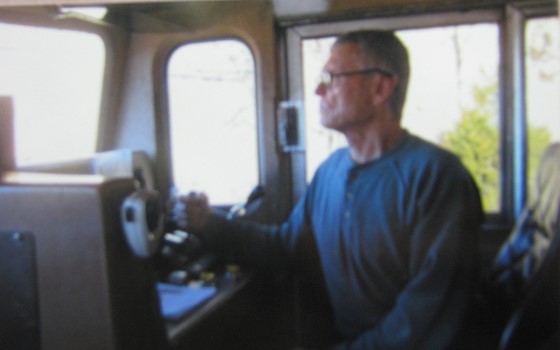
In the Office — Mike at work with his hand on the throttle in the cab of a modern diesel locomotive. He doesn’t remember what type it was, but it was probably lettered for the Union Pacific.
There were three types of engineers on the old Cotton Belt: stretch braker, dynamic braker, and free runners. I was a stretch braker, which meant that I used the brakes to keep the train stretched slack free over the run. One of our engineers, B.R. Null. Big Rat we called him, was one of the best. Big Rat could feel what was going on through the length of his train. One time he told his conductor that he sensed a brake dragging five cars in front of the caboose. So, he smoothly stopped the train and had a rear-end crewman go inspect it. He was right — there was a grabbing brake five cars in front of the caboose. He could pass an advance slow signal at 70 mph and have the train under control for a smooth stop a quarter mile before the next absolute stop signal. I was never that good.
In my 34 years of railroad service, the name of my employer changed from the Cotton Belt, to the Southern pacific, and then to the Union Pacific. I ran everything on the roster from mainliners to switchers but could never remember the designations. The controls on all were similar. Some of the early GEs were rough riders, but the EMDs were always smooth. I ran trains over the tracks of the Cotton Belt, Southern Pacific, Kansas City Southern and the Katy and lived in six states. It was quite a time. And... oh yes, I learned about the ETMRC by googling on the internet.
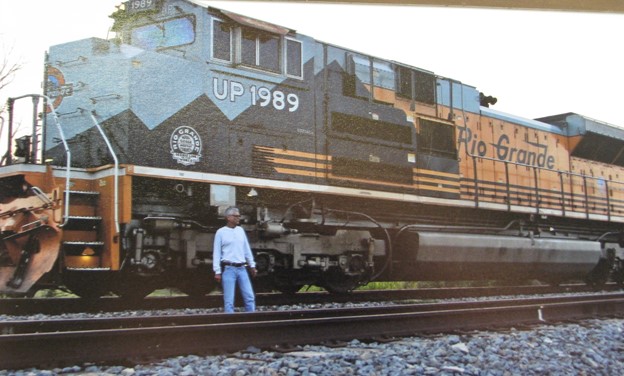
In the Hole — Mike is outside standing by his UP SD 70ACe in D&RGW heritage paint waiting for an oncoming train to clear.
| ETMRC Railnews — January 2022 — https://etmrc.org | |
|---|---|
| Railnews is electronically distributed in the last week of each month to members and friends of the East Texas Model Railroad Club. For those who still live in caves, a small number of paper copies are available at the paperwork corner at the junction. Editor: Tom B. Opinions expressed are not necessarily attributable to anyone. | Officers Paul F, President Rob D, Vice President Ron M, Treasurer Bob E, Secretary |
---- end ----
