ETMRC

Vol 17, Nr. 5 — May 2017 http://etmrc.org
|
|
 The Prez sez —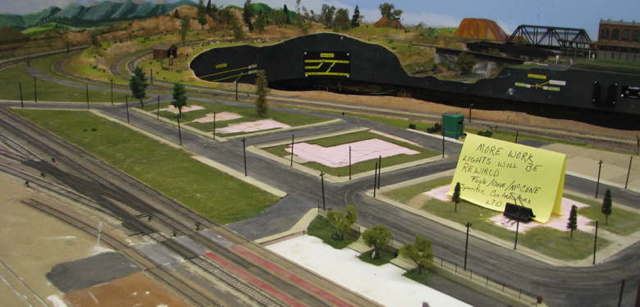
Urban Renewal? – The whole southern end of Williamsburgh was cleared to facilitate replacement, rewiring and moving of the fluorescent lights over the layout. The process was repeated over the Chyrokes yard. Six non-functional fluorescent tubes were replaced, and two light fixtures with bad ballasts were replaced by the Electrical Club the first weekend of work. Rewiring and movement of the fixtures over the aisles was scheduled to be completed the following weekend.
THE ROAD AHEAD
Nobody really thought the relief from facility repairs would last – and they were right. Late in April, the ETMRC Electricians Club (Paul F, Rob D, Tom McC) started to replace some of the nonfunctioning fluorescent lamps over the layout. Some had been down many months Sounds easy, right? Then the bad news started to arrive. The lights were originally installed more than 30 years ago, and the ballasts in the old fixtures were obsolete. Two ballasts were bad. Since these could not be replaced with usual hardware store versions,it was far more practical to replace the fixtures.. Then the clubmembers discovered some wiring problems that urgently needed to be fixed. The whole system did not conform with any known code. The wire was much too small for the usual operating current, and the connections were irregular in many places and just plain wrong in others. The entire system was a fire hazard. To make the situation worse, the ceiling is about 13 feet above the layout, which means a tall stepladder is necessary just to reach them. And this, of course means that everything in the way had to be moved, and elaborate arrangements of shims and blocks assembled to support temporary plywood platform for the ladder to protect everything else. The Electricians Club completed the replacement of six tubes and two fixtures, over the first weekend of work. To simplify future bulb replacements, they decided to relocate the fixtures over the aisles at the same time they replaced the faulty wiring, but for now everything on the city and yard peninsulas is non-operational.
Elsewhere in the clubhouse, things were still being done. The big pile of copper in the meeting room, which displaced our April meeting, is almost ready to go for recycling. Bob A relaid some track on the N-gauge layout to eliminate a kink and a dip that sometimes fouled six axle locomotives. Ron M and Bob T worked on the narrow gauge turntable, which has been unusable for some time, but now it mostly works. Paul trucked in his lawnmower and cut the grass along the club entrance, and Bob T has rebuilt most of the damaged or relocated signals on the layout, while continuing to update his manuals. Tom McC almost finished his rebuilding of the mine installation on the middle peninsula, and Ron M continued reworking buildings and building foundations all around the layout.
There’s a pattern here. You see the same nomes popping up in every story in every issue. We owe those folks lot of gratitude for keeping things going and just plain doing what needs to be done. There’s always a risk in trying to name names, so let’s recognize just one: President Paul. He’s a tough act to follow. Thanks, Paul.
MEETINGS
The official weekly club work sessions are 9:00 to noon on Saturdays. The business meeting is the first Saturday of the month at sort of the same time. Some members are often present for work sessions, or just plain lollygagging on Wednesday and Friday mornings, about the same time as the Saturday schedule. but lately this has become a bit uncertain. If you want to come on a weekday morning and don’t have a key, it is best to call someone. For those not yet retired, a group meets starting about 7:00 pm on Tuesday evenings for a couple of hours. Many meet at 8:00 Saturday mornings at McKay’s Restaurant on 1113 Main Street, Commerce for breakfast, and extend an invitation to any who care to join them.
NOTICE — The next scheduled business meeting is 9:00 am, Saturday, May 6, 2017.
April BUSINESS MEETING SUMMARY
NOT from Bob Erwin, Secretary
MEETING CALLED TO ORDER: 9:19 am, April 1, 2017.
PRESENT: Paul F, Rob D, Tom B, Bob A, Ron M, LeRoy H , Bob T, George W, Tom McC, Jared P.
PROXIES: None
MINUTES OF PREVIOUS MEETING: March minutes approved as published.
TREASURER'S REPORT: Submitted by Treasurer Ron M
This section is redacted
COUNCIL MEETING REPORT: Submitted by Council Rep Paul F
Really short report — Paul couldn’t attend, so no one did. The next Council meeting is May 16, 2017. Paul asked for possible volunteers for alternates, but no one volunteered. Seems that with our geriatric membership, most have a problem driving after dark, especially in Dallas traffic. Since we face penalties if we aren't regularly represented, we have a problem.
ETMRC BUSINESS: Submitted by Rob Dove, volunteer
Elections: Paul reminded that we must elect or re-elect club officers — we are already a month behind club by-laws requirements. Optimistic as usual, he asked for nominations or volunteers. There were none. Leroy moved that current officers be retained if they consented. Tom McC seconded. Officers present were underwhelmed but accepted, and were reelected almost instantly by acclimation. That even included Bob E, who was absent, so he could not decline.
Paul spent most of a recent Sunday cleaning track — nothing new here, but his commentary was. Much of his time was wasted in picking little bits of paper towel from switch points, frogs, ballast, and most everywhere else. To prevent repetition of the problem, Paul brought in some old T-shirts to be cut up and used in place of paper towels. This is in addition to the roll of cotton fabric we already have on hand. The moral of this story: DON’T use paper towels to clean the track. Use cloth. The cloth is stored on the shelf on the east wall of the new meeting room.
Paul also reported that Volume 2 of the club’s Diesel Spotter’s Guide is MIA. Please
check your stuff to see if you have it and forgot it. We have volume 1, but that is only for the first couple of diesel generations up to the 1980s or so. Volume 2 is much more current, so if you are trying to figure out what strange beast you saw recently, you may be out of luck until Volume 2 is found.
A couple of folks have remarked that the little silver uncoupling magnets along the tracks are hard to see. Once there were signs marking their location, but these have mostly gone the way af most layout signs — nobody knows where. Some discussion followed. Among the suggestions was replacing the signs, but most members thought that would be a short term fix at best, especially if there is any work of any kind going on in the area. Bob T suggested that the little tin “spoilers” that are in between the rails in some places be used as a spotting feature, but these too have been moved aside, sometimes to avoid short circuits. Bob then suggested that a dab of yellow paint be applied to the sides of the rails to mark the magnets. The Blacklands Railroad uses this technique to mark the locations of culverts, so there is a prototype precedent. There is one place where this approach wouldn’t work: the Williamsburgh station platform, which covers the sides of the rails, but elsewhere it would work. Most members thought it would be a good idea, but it was never formalized, much less voted on.
Rob D brought up the issue of power tool safety, a critically important issue for the club. Many members are familiar with the potential hazards of power tools larger than a Dremel tool, but unless you work with them fairly regularly, it is easy to forget that misuse can cause serious injury, permanent disability, or death. And even a Dremel tool can be hazardous if misused. Rob emphasized that the single most important thing one can do is THINK before you act, but he also provided a short list of guidelines.
- Don’t distract the operator
- Don’t use an unfamiliar tool without instruction, and then not by yourself
- Don’t use tools you can’t control. Whether too heavy, cumbersome, or can kickback.
- Do use protective appliances or personal equipment such as protective eyewear.
- Again, think before using about:
- What happens if you slip
- Inspect materials to be cut for nails, wires, or any other irregularities that could damage the tool or you
- Is anyone at possible risk (including you) with what you want to do? If there is even a remote possibility make sure you both know what’s going to happen.
- Keep combustible materials away from the portable heaters, both kerosene and electric.
- Moral: take a few minutes to make sure. It’s a lot easier than months of recovery or death.
In a rare moment of amity, most members present agreed that these are important considerations, and that maybe a sign posted in the work/meeting room to remind us that safety requires mostly awareness.
Bob T is continuing to update the club website and needs historical photos and other
information.
WHAT THE %*##% --?
A section to list strange happenings that really should be tracked down and fixed: Anyone? Anything?
Some derailments and control irregularities occurred where there wasn’t a problem before. Paul carefully reviewed some of the problem areas. A couple were caused by fragments of paper towels used to clean the track. Use the cloth swatches instead of paper. Derailments were traced to track gauge changes, probably resulting form the wide swings in temperature and humidity. If you encounter these, try to find and fix the problem. At minimum, mark the problem area to speed necessary repairs.
INFORMATION:
The following web sites are excellent sources of supplies (1) and technical data (2). (3) Is Rob D’s blog on the Model Railroad Hobbyist website. It is updated almost daily. Two of our members also have personal web sites (4) and (5). Site (5) is Bob T’s summary of northeast Texas railroads. Site (6) has some interesting photos of Commerce area railroading over the years.
- Cyberspace World Railroad for supplies
- http://www.geocities.com/budb3/index.html for technical data
- http://model-railroad-hobbyist.com/node/18644?
- http://www.coslar.us for Ed M's personal web site
- http://geusnet.com/~rteeter/ for Bob T's personal web site
- www.tamu-commerce.edu/library/collections/digital for Commerce Texas photos
COMING ATTRACTIONS:
May 16 – 17, 2017 — North Texas Council of Railroad Clubs, Irving.
May 20, 2017 — LSR Div. 3 Meeting, Christ the Servant Lutheran Church, Allen
June 7 to 11, 2017 — NMRA LSR Convention, Houston
REGIONAL RAILROAD PROTOTYPE NEWS
This is just a sampling of that’s going on in our area, which is defined to be whatever I think interesting, so the area can be fairly large. Or not.
Last month was Rob D’s self portrait of his interest in trains and model railroading. This month it’s my turn. I’ll be asking every member to participate, so take cover. You’re on my list.
Was There Anything before?
By Tom B

I don’t remember a time when I wasn’t interested in trains. At one time, my family lived about 150 feet from a railroad, and my mother was fond of telling folks that as a 3-year old, I wouldn’t go to sleep until she held me up to see the 9:00 pm northbound train go past. Lionel O-27 trains were next, but before I was 8, I got interested in building models, starting with 35-cent Strombecker wood and cardboard kits. The steam locomotive was an all wood 2-8-2 Mikado. With a short stub of a Tinkertoy stick glued to the top of the smokebox front, looked sort of like the H-10 Mikados I saw on the MC main — my first kitbash. And Mikados are still my favorite.
My interest in trolleys, prototype and models, began in the early 1950s on family trips east. We had an aunt and uncle in Cleveland, Ohio, who lived near the last streetcar line in the city. When I'd discovered it, I was instantly hooked. From then on, I attempted to model some of the Cleveland streetcars, and then moved to the last interurban line in Cleveland. My first more or less successful attempt at scratchbuiding was LSE 165, in 1/8 inch scale, about 10% too small. About this same time, I started to build an outside railroad. Those materials formed the beginning of my current 7-1/2 inch gauge railroad around our Texas property.
So that’s where everything began, and it really never stopped. My wife has been unfailing supportive, and even built a station. My home layout was started about 50 years ago, and has been moved many times, but is still pretty much the same and has some of the original still in it. Should I start over? PRobably. But if I were to start again, it would probably be in O-gauge, which means that all my lovingly kit bashed locomotives, other rolling stock, and scratchbuilt buildings would be worthless, so that will never happen. My first magazine article appeared in Traction and Models, a long gone trolley-oriented magazine in August 1974. Then I got recruited by Tony Koester, then the editor of RMC, to do a story in RMC 1980, and done some others for RMC occasionally since then. My most recent stuff appeared in the 2017 edition of the MR Model Railroad Planning magazine, again the Tony Koester connection.
But it has been a most interesting adventure. Now I imagine a lot but usually get little done. But were I to go back, I suspect I’d do it all over again.
|
ETMRC Railnews — May 2017 —
http://etmrc.org
| |
Railnews is electronically distributed in the last week of each month to members and friends of the East Texas Model Railroad Club. For those who still live in caves, a small number of paper copies are available at the paperwork corner at the junction. Editor: Tom B. Opinions expressed are not necessarily attributable to anyone. |
Officers |