ETMRC

Vol 16, Nr. 8 — August 2016 http://etmrc.org
|
|
 The Prez sez —
Ladder for Price Yard – Bob T is using all the latest tools and products to build the turnouts for the new west side entrance to Price Yard.
THE ROAD AHEAD
It seems impossible, but we need to be looking to the open house(s) for the Bois
d’arc Bash and the Cotton Belt Symposium. Last year, they were on the same date, but that might not be the case this year. But even if not the same day, they will probably be
about a week or so apart. The facility improvements are ongoing, but most likely will be only slightly further along by late September. The N-gauge layout is better than ever, thanks to the efforts of Ron M andBob A. The King trolley layout has seen much work, mostly by Ron M reassembling disintegrating buildings and dressing up the scenery, but the main HO layout has lots of room for improvement: the locomotive facilities including the
roundhouse and turntable offer an opportunity for someone to step up and complete.
A lot of work has been done on the HO layout. Besides Bob A’s work on the rock faces on the middle peninsula, Ron M has leveled and rested many buildings in Williamsburgh, which are a big improvement. And shortly after the end of the July business meeting, members exhumed the Topside Creeper on long term loan to the club, and Bob A used it to install the new turnout to the Price Yard staging area, as well as inspecting the curved crossover, to see if there were simple fixes to the crossover to make it more reliable. But there is much more to be done. And — we even have some time to do it.
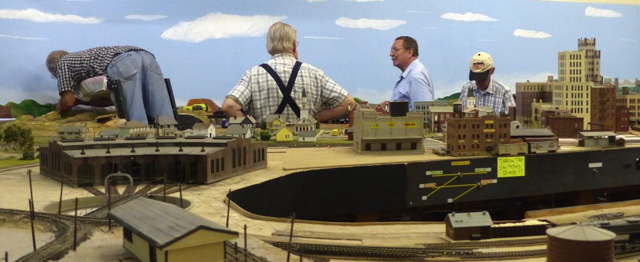
Workin’ on the Railroad — Here are Bob A (on the Overhead Traveller) who was installing the turnout to the west end connection to Price Yard, Bob T who was supervising, Paul who, as President, was trying to find what was going on, and LeRoy, doing something.
MEETINGS
The official weekly club work sessions are 9:00 to noon on Saturdays. The business meeting is the first Saturday of the month at sort of the same time. Some members are often present for work sessions, or just plain lollygagging on Wednesday and Friday mornings, about the same time as the Saturday schedule. but lately this has become a bit uncertain. If you want to come on a weekday morning and don’t have a key, it is best to call someone. For those not yet retired, a group meets starting about 7:00 pm on Tuesday evenings for a couple of hours. Many meet at 8:00 Saturday mornings at McKay’s Restaurant on 1113 Main Street, Commerce for breakfast, and extend an invitation to any who care to join them.
The next scheduled business meeting is 9:00 am, Saturday, August 6, 2016.. This as a return to our usual schedule. The change reported last month for the July 4 holiday didn’t happen, so in this case it is good that details aren’t usually read and understood.
July BUSINESS MEETING SUMMARY
reported by Rob Dove
MEETING CALLED TO ORDER: July 2, 9:25 am
PRESENT: Paul F, Ron M, LeRoy H, Bob T,Ray Y, Tom McC, Tom B
PROXIES: One
MINUTES OF PREVIOUS MEETING: Minutes of the last meeting were approved — sort of by a very informal formal vote. Some things never change.
TREASURER'S REPORT: Submitted by Treasurer Ron M
This section is redacted
COUNCIL MEETING REPORT: Submitted by Council Rep Paul F
No meeting was scheduled for June — cancelled on the day of the scheduled meeting.
ETMRC BUSINESS:
Note the title. If something is really new, it will be listed, but most of the items are ongoing, so the difference between new and old business is almost negligible.
Bob T thinks the newsletter file needs to be organized and filled in, as the Railnews is the only written history we have. Hard copies of most of the issues since 2012 or so are informally stashed in an unmarked folder at the north end of the layout room, but are not in any sort of order, and may be incomplete. Bob has been converting the monthly issues into a more compact format and has posted most of the files on the club web site, but a hard copy file is desirable. He will print any missing copies as far as his files go, but someone needs to organize and maintain the files. In addition, Tom B has files in both pages and pdf format or the as-filed newsletters from 2014 to the present. His files of the earlier issues were lost when his old computer died. Rob D volunteered to get things in order and was shown the informal file to start with.
LeRoy wondered about the absence of water under the air conditioning unit in new room 1. There is a veritable Lake Commerce outside under the large unit in the layout room. Rob explained that there is now a similar puddle under the newer unit, but since the unit is smaller, so is the puddle. The puddle is the result of Rob’s cleaning the filters and drains. The unit has been running nonstop since its installation, and the drains were plugged, so the condensate was trapped inside the unit and evaporated by the heat of the condenser motor. Since the cleaning in mid-June, the unit has been running cooler and the room is cooler. Congratulations to Rob.
Paul talked about the broken urinal, which has been on the repair list for a couple of years. Tom B reported that a plumber that lives on his street who might be interested in fixing it. In the ensuing discussion, the need for the facility was questioned, and if it were abandoned, the crowded area around the washstand might be enlarged, and the existing but uninstalled laundry sink might be more useful in the enlarged area. Bob T moved that the drain be capped and the urinal discarded. The motion was seconded by Rob D and the motion passed on a 6-1 vote. The drain will be capped and the wall over the hole patched.
Paul also commented that after he’d finished cleaning the track and run a single train around the layout, the track was dirty all over again. The problem was traced to an unassuming plastic boxcar with plastic wheels. In the somewhat chaotic discussion that followed, the idea that car wheels should be cleaned at least annually, and more often if needed, was raised. The fact that the club had decided some time ago to bar the use of plastic wheels also came up. It turned out that car in question didn’t have plastic wheels, but had Kadee wheelsets — diecast zamac wheels on plastic axles. The Kadee wheels seem to be somewhat porous and can accumulate enough dirt that they won’t stay on the track. While they can be cleaned using a weak solvent such as denatured alcohol, or mechanically, the majority believed that Kadee wheelsets might be considered as bad as plastic, but the issue was not submitted for a formal vote. It was also noted that any wheels of any material can get gummed up and need to be cleaned periodically. The overall feeling was that if you run cars on the club tracks, the wheels should be cleaned before
you start, and if you leave them on the layout, they need to be checked periodically to make sure they are not contributing to the dirty track problem. Rob also mentioned that because of our dusty environment, we might want to consider installing an electrostatic air cleaner in the layout rooms. He volunteered to investigate the cost and capacity of commercial units.
Bob T has been working on aligning the track for the west corner connection to Price yard. He wants to have the turnout to the new access from the outside loop installed after the meeting so he has a constant to go from. Bob A volunteered to install the turnout after the formal meeting ajourned. This request led automatically to a discussion of the famous curved turnout crossover. This installation mostly works, but long wheelbase locomotives sometimes “stub their toes” going through it southbound. With the route through the staging area, the crossover isn’t needed, and could be removed. More discussion, some pro and some con. The removal advocates noted that there is a crossover between the same two tracks in Dexter, which is not very useful, but there is also a similar crossover in the middle of the Wilson yard. If the curved crossover is removed it might make things in the corner more reliable, but in any case, if it is to be changed, the time to do it is when all the other changes are being made. Bob also mentioned that the changes to the signal system would be a relatively simple fix if the crossover was
removed.
Tom B remarked that if anyone ever wants to run passenger trains, the curved crossover allows all the trains to pass all the existing depots between Dexter and Allenport in both directions smoothly. This triggered more discussion, which finally was resolved by everyone agreeing to first see if there was any obvious rough spot that could be easily fixed, and if so, fix it. If not, pin the points of both turnouts to the mainline position, and work to make sure the passage is as smooth as possible. Paul mentioned that both turnouts were already pinned and had been tinkered with in the past. LeRoy wondered if there was any room for an access hatch in the area to simplify the maintenance and adjustments. There isn’t. At the close of the meeting, no decisions to do anything but check were made, and even that wasn’t really a decision, but more of mutual acceptance. So for now, at least, the curved crossover stays, subject to change at any
time.
The meeting was adjourned at 10:25.
WHAT THE %*##% --?
A section to list strange happenings that really should be tracked down and fixed: Anyone? Anything?
Not much here this month. It is most likely that the gremlins are hiding for a while.
INFORMATION:
The following web sites are excellent sources of supplies (1) and technical data (2). (3) Is Rob D’s blog on the Model Railroad Hobbyist website. It is updated almost daily. Two of our members also have personal web sites (4) and (5). Site (5) is Bob T’s summary of northeast Texas railroads. Site (6) has some interesting photos of Commerce area railroading over the years.
- Cyberspace World Railroad for supplies
- http://www.geocities.com/budb3/index.html for technical data
- http://model-railroad-hobbyist.com/node/18644?
- http://www.coslar.us for Ed M's personal web site
- http://geusnet.com/~rteeter/ for Bob T's personal web site
- www.tamu-commerce.edu/library/collections/digital for Commerce Texas photos
COMING ATTRACTIONS:
August 13, 2016 —NMRA LSR Division 3 Meeting — Christ the Servant Lutheran Church, Allen
August 16, 2016 — North Texas Council of Railroad Clubs, — Irving.
REGIONAL RAILROAD PROTOTYPE NEWS
This is just a sampling of that’s going on in our area, which is defined to be whatever I think interesting, so the area can be fairly large. Or not. Recently, we’ve been looking at Hunt County dead railroads. This month, we look at narrow gauge operations in Hunt County. Source: American Narrow Gauge Railroads, George W. Hilton, Stanford University. Press, 1990.
The possibilities of narrow gauge as a cheaper and faster solution emerged in the early 1870s, but came of age a decade later. Perhaps the grandest scheme was the Grand Narrow Gauge Trunk, which was to connect Toledo, Ohio to Laredo with three main companies, the Toledo and Saint Louis RR, the St Louis and Cairo, and the Texas and St Louis. While never quite complete to Laredo, the Great Narrow Gauge Trunk made it as far as Leon Junction, Tx, a little more than 300 miles from Laredo. The predecessors of what is now the Blacklands (old Cotton Belt) and the Kansas City Southern were both planned as narrow gauge railroads, but in Hunt County, only one was built that way.
What became the Cotton Belt began with the Tyler Tap Railroad. The Tyler Tap had a problem selecting gauge. When chartered in 1871, it was standard gauge. But when track laying began in 1876, it was 3-foot narrow gauge. Starting at Tyler, Tx, the 3-foot gauge went north, first to Big Sandy, to a T&P interchange, and to Mt Pleasant, where it turned east to Texarkana, which it reached in 1880 and continued northeasterly into Arkansas and Missouri. The name was changed to the Texas and St. Louis in 1879 and was the western end of the Grand Narrow Gauge Trunk. Grading of the line west from Mt. Pleasant, originally intended to go to Dallas via Commerce, began in 1879. Tracklaying began in 1882 — but as a standard gauge line. The first train to Commerce arrived in 1887. Construction on the line to Sherman and dipping south to Greenville, then west to Ft Worth, continued that year. By the late 1880s the appeal of the narrow gauge faded rapidly, and plans began to convert the whole 725 miles of T&StL main line narrow gauge track to standard gauge. Up to the conversion, the T&StL was second in total length only the the D&RGW lines further west. Conversion occurred in two phases: The 419 mile-line east of Texas on October18, 1886, the longest conversion in a single day, - and the remaining Texas narrow gauge lines in January, 1887.
The present KCS line in Hunt County began as the East Line and Red River Railway. The EL&RR began in Jefferson,TX in 1876. Track reached Dangerfield in 1878, Sulphur Springs in 1879, and Greenville in late 1880. Construction continued west reaching McKinney in 1882. Just the Greenville-McKinney segment was standard gauged in 1887. The corporate structure of the EL&RR was tortured. The railroad was bought by Jay Gould and incorporated into his (at the time) MKT in 1891. Gould was obliged by the courts to separate the EL&RR in early 1892. The line was renamed to Sherman, Shreveport and Southern in early 1872, the remaining 122 miles of narrow gauge track converted to standard gauge September 13, 1882. The line was extended to Shreveport in 1900 and sold to the Louisiana Navigation and Railway in 1923, to the Louisiana and Texas Railway in 1929, and finally to the KCS in 1939.
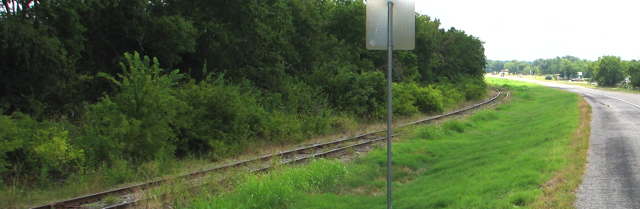
Graded for Narrow Gauge – Blacklands Railroad east of Commerce, with minimal grading and lots curves and dips is typical narrow gauge thinking, even though it was built standard gauge. The narrow gauge heritage remains visible today, after more than 100 years of improvements.
Breaking News
On July 24, The clubhouse got clobbered again by a fallen tree, along with the much needed rain. The tree was the same Hackberry tree that the other two episodes of fallen branches, one of which punched holes in the roof that we repaired. There’s still one trunk of that particular tree left. But it appears to be leaning away from the building. Nobody’s been up on the roof to check for damage yet.
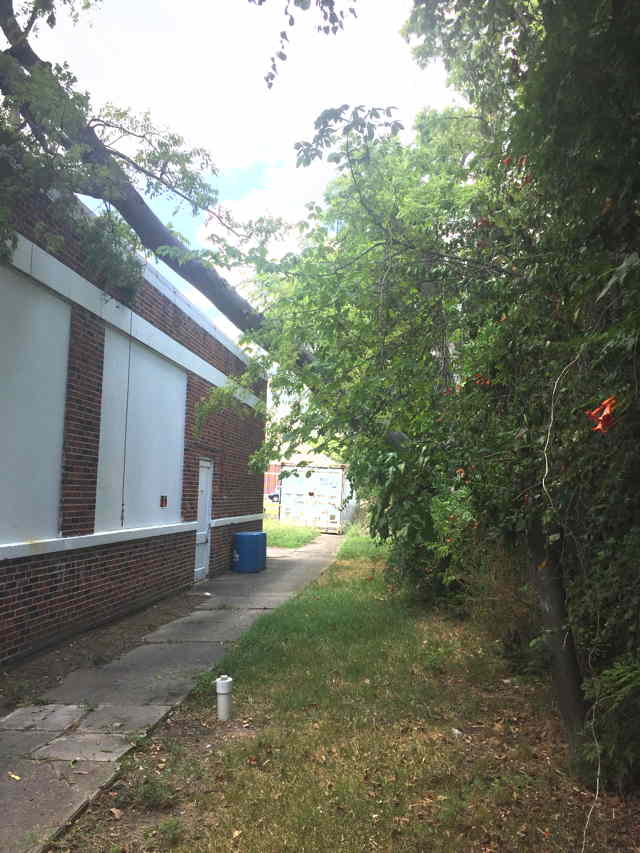
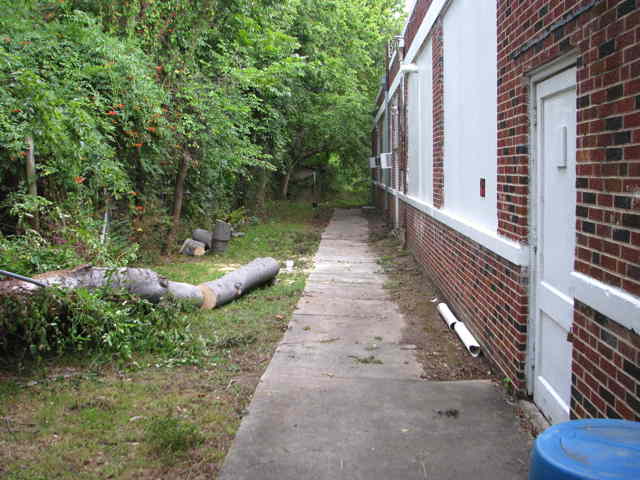
A Trunk, not Branches – fell on the clubhouse sometime Sunday, July 24, and here is how it looked on Monday (left). Sometime after Bob T took the first photo, the tree slipped off the top of the wall, taking off the plastic sewer vent pipe and blocking the sidewalk. Club members stated cleaning up the mess 9:00am Wednesday, and by 6:00 pm it was mostly gone (second photo), thanks to the efforts of Rob D, Ron M, and Paul Fogel. Should we add “forester” to our club name?
|
ETMRC Railnews — August 2016 —
http://etmrc.org
| |
Railnews is electronically distributed in the last week of each month to members and friends of the East Texas Model Railroad Club. For those who still live in caves, a small number of paper copies are available at the paperwork corner at the junction. Editor: Tom B. Opinions expressed are not necessarily attributable to anyone. |
Officers |